

The Chinese Language and Its Transcriptions
Several dialects exist in China, between which there can sometimes be very large differences. Of these, the Dear Visitor will encounter two variants here. The first is the so-called Cantonese dialect, also known as Yutyu (Yueyu) or Gwongdungwa (Guangdonghua). It is spoken mainly in southern China, in Guangdong (Gwongdung) province and its surrounding areas. The city of Foshan (Fatsaan), which is the center of the development of Wing Chun, lies in this region, as does Hong Kong (Heunggong, Xianggang), therefore most masters speak (or spoke) this language.
The second is the northern dialect (mainly Beijing and its surroundings), which is currently the official language of China. Its use is justified by the fact that nowadays materials about Wing Chun have also appeared within the People’s Republic of China (including bilingual Chinese-English versions), in which names are presented according to the official writing system. I have written these using the Latin-based transcription introduced in China (pinyin). The northern variants of the words are indicated in italics and placed in parentheses.
Today, there exists a transcription created in China for the Cantonese dialect, which is much more precise than the various English-based transcriptions and (especially for us) more usable (it was published in the late 1990s). This transcription is called Jyutping, and with minor differences it follows the pronunciation rules of Pinyin. For a long time, I used this transcription.
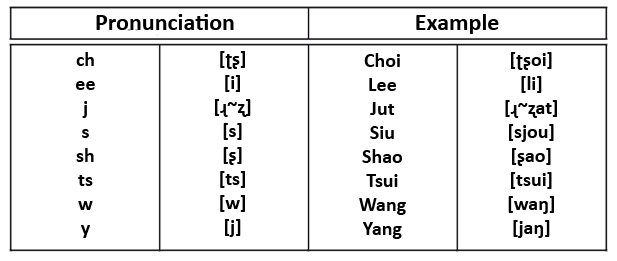
On this page I have used the Yale transcription system, but for easier orientation in Western literature, I also present the transcription below according to the Wade–Giles system used in the West.
The reason for the transition was the uncertainty in the pronunciation of English-based transcriptions (especially in the case of vowels).
In the Wade–Giles system, the letter “u” can represent the sounds u, ju, and ü. The letter “a” may correspond to a, e, or é. The letter “i” can be i, but also ai. Moreover, words were often transcribed based solely on hearing, which further increased the confusion (not to mention that sounds such as “ty” cannot even be properly interpreted in English, and thus appear as J, Ch, or Ts in different transcriptions). The transcription used in the Wenlin dictionary is much clearer and simpler.
Cantonese, like northern Chinese, is a tonal language. It has three basic tones: \ falling, / rising, and – level. A low pitch is indicated by an h following the letter (within the word). Therefore, an h at the beginning of a word is pronounced as a normal h sound (e.g. Han), while one within the word (e.g. Wihng) is not pronounced, or only very softly pronounced.
Altogether, six tones exist (first according to Jyutping, then according to the Yale transcription):
high falling: wing\ wing1
high rising: wing/ wing2
mid-level: wing– wing3
low falling: wihng\ wing4
low rising: wihng/ wing5
low level: wihng– wing6
A high level tone also occurs in some variants of the high falling tone, but it cannot really be distinguished from the high falling tone. The pronunciation of consonants sounds approximately the same in both the northern and southern dialects. Cantonese does not distinguish between the sounds j and zh, or q and ch; only j and ch are used. Compared to Hungarian, the difference is that the sounds “j” and “ch” are formed at the front of the mouth rather than at the back. X, q, z, zh do not occur at all. The ng sound can also appear at the beginning of a word (in the northern dialect, ng can only occur word-finally).
Yale Transcription
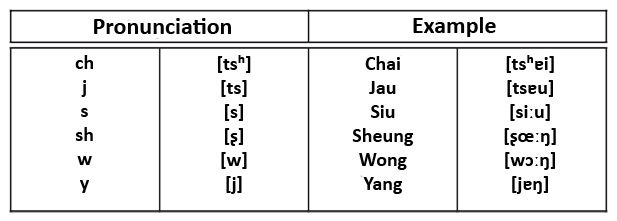
In the case of ng, similarly to English, the g is not pronounced clearly; rather, it indicates the emphasis of the n. The s and sh sounds are pronounced somewhat lisped (both in the north and the south). Within a word, u often sounds more like v. The pronunciation of w is like in English. The pronunciation of vowels follows Hungarian orthography: the letter “a” represents the sound a, “u” represents u, and “e” represents e. There are only two exceptions. The letter combination yu within a word sounds like a softly pronounced ü (e.g. the pronunciation of hyun is hün). The other is the letter combination eu, where e is usually unstressed and u indicates a more melodic pronunciation (e.g. the word cheun – spring – is pronounced chun in the south as well). This appears mainly when adopting the northern form. Where two sounds are pronounced in the north, both are also pronounced in the south (e.g. liang, leung). This is the only inconsistency of the transcription.
Pinyin Transcription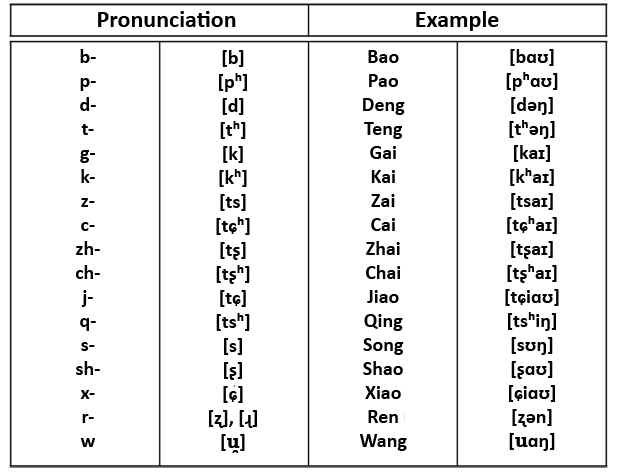
Wade-Giles Transcription