


The History of Wing Chun
The history of the style is told in nearly the same way by schools belonging to the same lineage. However, among schools that separated long ago, there can be significant differences. Generally, the events are told in three basic versions:
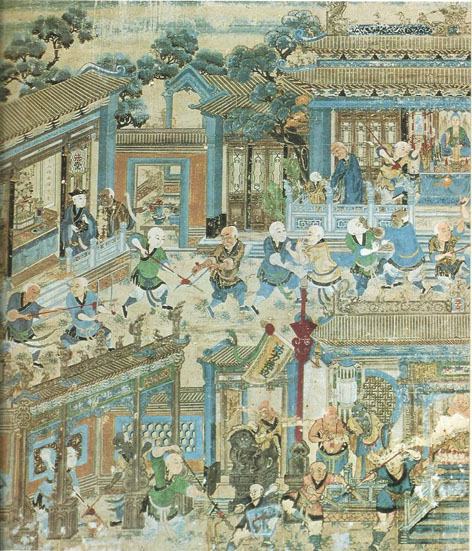
1. The style originates from the Shaolin nun Ng Mui and her student Yim Wing Chun. The style is named Wing Chun after Yim Wing Chun.
2. The style was developed in the Shaolin Temple and spread after the destruction of the monastery. The masters who created it always gathered in a hall of the monastery called Weng Chun Tong (Yong Chun Tang, Hall of Eternal Spring). The style takes its name from this.
3. The style was created by Shaolin monks hiding on the “Red Boat” and members of various secret societies. Here, the name of the style comes from key words of a motto.
At first glance, the masters of the style seem to have preserved contradictory stories about the origin of Wing Chun, but in reality these are only apparent contradictions. If we examine these “historical fragments” one by one, a story emerges that seems to explain all the others, and it also becomes understandable how the different versions developed. This is what I will explain below.
Weng Chun Tong (永春堂)
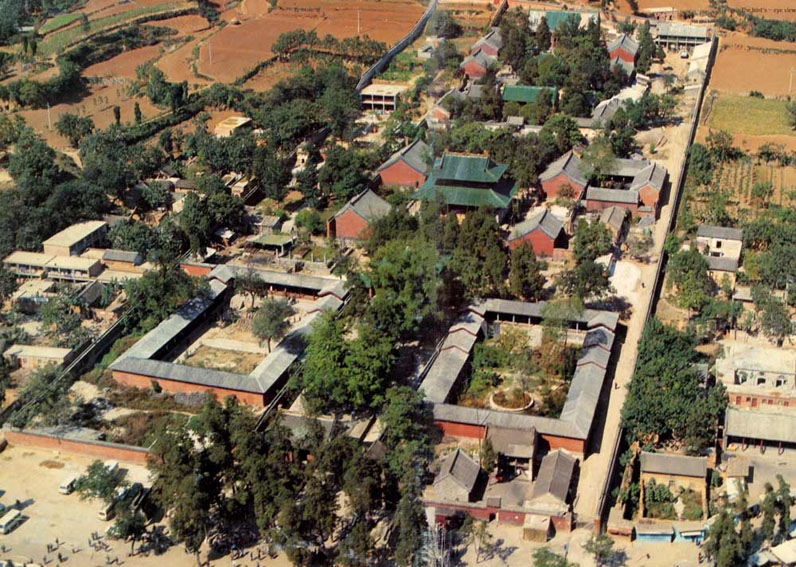
After the Manchu conquest, monks and the clans supporting them were systematically hunted. The authorities were familiar with the monks’ fighting styles and had obtained several of the previously secret manuals describing techniques. In the Fujian monastery, a few masters began developing a new style. This style was specifically intended for training secret societies. Therefore, a lesser-known system of exercises was selected. As a foundation, they used the Crane and Snake styles (modifying the hand techniques of both), but they also incorporated elements from other styles, including, surprisingly, Tiger and Dragon techniques, as well as a separate Lap Sau exercise series. The fundamentals remained the same; the method of combination became new.
Since the government punished even the possession of weapons with death, only the use of double short knives was included in the new system. (The Cantonese short knives closely resemble the meat cleavers found in every household, differing mainly by having a hand guard. Thus, cleavers could be used as weapons or easily adapted for combat.)
According to tradition, the masters working on the style always gathered in a hall of the monastery called Weng Chun Tong (Hall of Eternal Spring). The style takes its name from this. Among the earliest known representatives of the new style were three masters: Ji Sin (Zhi Shan), the abbot of the monastery, and two nuns, Ng Mui (Wu Mei) and Yat Chan (Yi Chen).
The Founders
Ng Mui was a highly skilled master of Shaolin martial arts and is regarded as the founder of several styles (Wing Chun, Ng Mui Pai, Dragon Fist). She participated in several duels, some of them deadly. According to one story, a 14-year-old boy, Fong Sai Yuk, became involved in a life-or-death fight and had to kill his opponent. The opponent’s father, Li Ba Saan, swore revenge and challenged the boy. Ng Mui tried to dissuade Li from fighting, but he refused. Though already 75 years old, Ng Mui decided to fight in the boy’s place. During the fight, she attempted to subdue Li without seriously injuring him, but he was too skilled. In one counterattack, she knocked him down with a kick, which proved fatal. The saved boy, Fong Sai Yuk, later became a famous fighter.
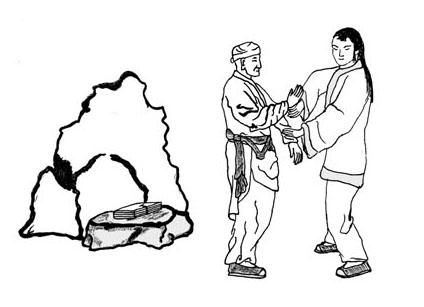 Ng Mui and Yim Wing Chun
Ng Mui was also forced to flee and, after long wandering, found refuge in a small Taoist temple called White Crane, where she was safe from her pursuers. (The temple is located on Daai Leung Mountain, on the border of Sichuan and Yunnan.) She continued refining the new style there, incorporating Taoist principles alongside Buddhist foundations, especially those related to softness and the functioning of yin and yang. After completing her system, she left the temple, traveled the country, and taught the new style in various monastic communities.
During one of her journeys, Ng Mui met a merchant from Fatsaan (Foshan), Yim Yi. He told her that his daughter, Yim Wing Chun, was engaged, but a local gang leader refused to accept this and wanted the girl for himself. Yim had some martial arts knowledge and had taught his daughter, but it was not enough. Ng Mui offered her help. They informed the gang leader that they agreed to the marriage but requested time for preparations. Ng Mui took Wing Chun with her and began training her. After a year, she judged that the girl was ready. Yim Yi told the gang that Wing Chun would marry whoever could defeat her in combat. When the confrontation took place, the bandit tried to overwhelm her, but she easily deflected his attacks and threw him down. After repeated failed attempts, his companions joined in, but they too were quickly defeated. They were forced to admit defeat, and Wing Chun married her chosen partner, Leung Bok Chau. She continued training with Ng Mui for another three years.
Yim Wing Chun then adopted the name Wing Chun, modifying the characters, as the original “Weng” form was used only in male names. The term Weng Chun likely served as a prearranged identifying code, as it appeared in multiple names and even in poems and mottos.
After Yim Yi’s death, Wing Chun and her husband moved to Guangzhou. Leung Bok Chau also learned the style from his wife. They passed their knowledge to only one person, a merchant from Guangxi, Leung Laan Gwai.
Shaolin Masters and the Red Boats
The Shaolin masters likely anticipated that they would not be able to defend the monastery, as after its destruction they did not flee randomly. Many joined southern opera troupes. In China, actors traditionally receive martial arts training to perform combat scenes convincingly, and they wear heavy facial makeup, making it easier for martial artists to blend in. At that time, troupes traveled the country, performing wherever there was demand. Their identifying feature was the red-painted junk boats.
This also allowed the masters to organize anti-Manchu secret societies. The Red Boats, and later the area around Fatsaan, became centers for two such societies: the Tin Dei Wui (Heaven and Earth Society) and the Hung Fa Wui Gun (Red Flower Society).
After the temple’s destruction, Abbot Ji Sin worked as a cook on one of the opera boats, pretending to be simple-minded. At one location, a criminal known as “Tiger” Wong demanded protection money. When the troupe could not pay, he attacked their leader, Wong Wa Bou. The “simple cook” intervened and tried to subdue him without serious harm. Eventually, Ji Sin broke several of Wong’s fingers and then took him to the ground. Realizing he could not win, “Tiger” Wong left in humiliation. After this, several troupe members began learning from Ji Sin.
Yat Chan fled with her student Jeung Ng and took in two actors, “Taan Sau” Ng and “Hung Gan” Biu, as students. They later joined their companions on the Red Boats.
The Spread of the Style
Leung Laan Gwai, a student of Yim Wing Chun and Leung Bok Chau, taught Wong Wa Bou the Ng Mui version of Wing Chun. Ji Sin taught Leung Yi Tai the Shaolin single-ended pole technique, later combined with spear methods to form the Luk Dim Boon Gwun (Six-and-a-Half Point Pole).
Wing Chun, in its modern form, developed during this period among the Red Boat performers. Known masters of this era include Wong Wa Bou, Leung Yi Tai, Syun Gam, and Lai Fuk Syun.
Later, Leung Yi Tai passed the system to a physician from Fatsaan, Leung Jaan. Leung Jaan frequently tested his skills and earned the title “King of Kung Fu,” making the style popular in Fatsaan. He taught his sons and a few locals.
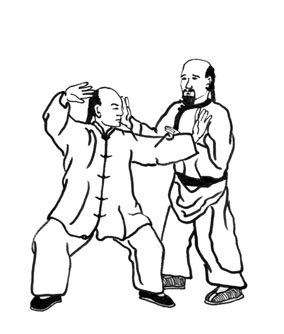 Leung Jaan's fight
One of his students, Chan Wa Seun, worked as a money changer. Seeing his interest, Leung Jaan accepted him as a student. Chan became well known and taught only sixteen students over four decades. Though invited to teach at the imperial court, he refused, citing incomplete knowledge—though the real reason was the style’s connection to secret societies. His last student became the most famous: Yip Man.
Yip Man, born in 1893 in Fatsaan, came from a wealthy family. He began training under Chan Wa Seun and later continued with senior students after Chan’s death. He gained fame through public fights. During World War II, he moved to Hong Kong and began teaching publicly at the Restaurant Workers’ Union. Among his students were Leung Sheung, Lok Yiu, Wong Shun Leung, William Cheung, and Bruce Lee. He was the first grandmaster to teach Wing Chun openly, helping it become one of the most popular martial arts styles and spreading it to the West.
The best-known versions of Wing Chun come from the “Yip Man branch,” but many other variations have also survived, mainly around Fatsaan.
